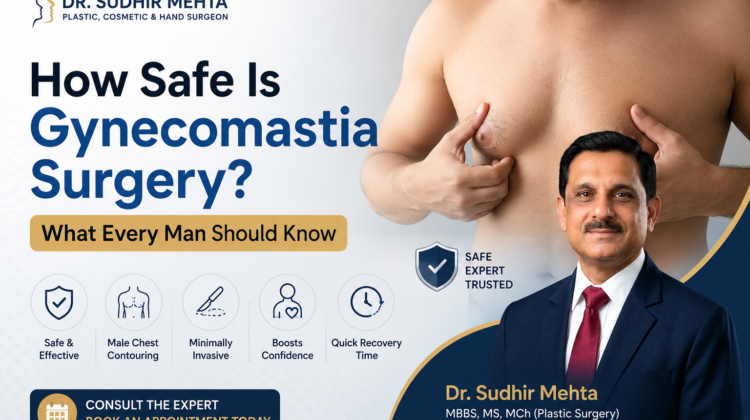
How Safe Is Gynecomastia Surgery? What Every Man Should Know
What is Gynecomastia?
Gynecomastia Surgery is the benign (non-cancerous) enlargement of glandular breast tissue in men. It is not the same as excess chest fat — it involves actual proliferation of breast gland tissue, often making it firm or tender to the touch. It can affect one or both sides of the chest and occurs across all age groups.
The condition is far more common than most men realise. Teenage boys, middle-aged men, and older adults can all be affected, each group for different physiological reasons.
Types of Gynecomastia
Surgeons classify gynecomastia into four grades based on the amount of excess tissue and the degree of skin laxity:
- Grade I — Minor enlargement, no excess skin, localised around the areola
- Grade II — Moderate enlargement covering most of the chest, no excess skin
- Grade III — Moderate-to-large enlargement with mild excess skin
- Grade IV — Marked enlargement with significant skin redundancy, resembling a female breast
Why Does Gynecomastia Happen?
The root cause is almost always a hormonal imbalance — specifically, a relative excess of oestrogen compared to testosterone. This imbalance can be triggered by:
- Puberty — the most common cause in adolescents; usually resolves on its own
- Ageing — testosterone naturally declines after 40, shifting the hormonal balance
- Medications — anabolic steroids, anti-androgens, some antidepressants, and heart medicines
- Medical conditions — liver disease, kidney failure, thyroid disorders, and tumours
- Recreational substances — alcohol, cannabis, heroin
- Idiopathic — no identifiable cause in up to 25% of cases
How Safe Is Gynecomastia Surgery? Medical Facts You Should Know
Gynecomastia surgery — technically called reduction mammaplasty — is one of the most commonly performed cosmetic procedures in men worldwide. When performed by a qualified, experienced surgeon in an accredited facility, it carries a strong safety profile comparable to other elective surgeries of similar scope.
Key Medical Facts About Gynecomastia Surgery
- It is performed under controlled conditions — either general anaesthesia or local anaesthesia with sedation
- Two main techniques are used: liposuction (for fatty tissue) and surgical excision (for glandular tissue), or a combination of both
- The procedure leaves minimal scarring — incisions are typically placed along the areolar border and are barely visible once healed
- Most patients go home the same day; hospitalisation is rarely required
- Results are long-lasting, provided underlying hormonal causes are addressed
What Makes Gynecomastia Surgery Safe?
- Pre-operative screening — a thorough medical history, blood tests, and hormone panel identify any contraindications before surgery is even scheduled.
- Experienced surgeon — a specialist in chest contouring reduces both operative time and the risk of tissue damage or asymmetry.
- Appropriate anaesthesia — the choice between general and local anaesthesia is tailored to the patient’s health status and the extent of correction required.
- Accredited facility — surgery performed in a certified operating theatre with proper sterilisation and emergency protocols dramatically lowers infection and anaesthetic risk.
- Post-operative care — wearing a compression garment, attending follow-up appointments, and avoiding strenuous activity during recovery are all evidence-backed safety steps.
Common Myths and Fears About Gynecomastia Surgery
Myth
“The surgery is extremely risky and can cause permanent nerve damage.”
Fact
Temporary numbness or altered sensation around the nipple is a common but short-term side effect. Permanent nerve damage is exceedingly rare when surgery is performed by a qualified surgeon.
Myth
“Gynecomastia always comes back after surgery.”
Fact
Recurrence is uncommon when the underlying hormonal cause is treated, and the patient maintains a stable weight. Surgical results are typically permanent.
Myth
“The recovery is lengthy and extremely painful.”
Fact
Most patients describe mild-to-moderate soreness, not severe pain, well-managed with oral analgesics. The majority return to desk work within a week.
Side Effects and Recovery: What to Expect Post-Surgery
Understanding the normal recovery trajectory removes much of the anxiety around surgery:
- Days 1–3:Mild swelling, bruising, and tenderness. A compression vest is worn continuously. Rest is advised.
- Days 4–7:Discomfort subsides significantly. Most patients return to light desk work. Drains, if placed, are usually removed by Day 3.
- Weeks 2–4:Swelling continues to reduce. Light walking is encouraged; strenuous exercise remains restricted.
- Weeks 6–8:Full resumption of gym and physical activity. The chest contour becomes visible as residual swelling resolves.
- Months 3–6:Final result fully apparent. Scars continue to fade and flatten.
Who Is an Ideal Candidate for Gynecomastia Surgery?
- Men with true glandular gynecomastia that has not resolved after 12 months of conservative management
- Physically healthy individuals with no uncontrolled medical conditions
- Non-smokers, or those willing to stop smoking 4–6 weeks before and after surgery
- Adults at a stable, near-ideal body weight
- Men with realistic expectations about outcomes and willing to follow post-operative instructions
- Teenagers are considered only when breast tissue has been stable for at least 2 years
Why Choose Dr Sudhir Mehta for Gynecomastia Surgery in Ambala?
Prof. Dr Sudhir Mehta brings decades of surgical expertise to each procedure. Practising out of Ambala, Haryana, Dr Mehta’s practice is built on three pillars: thorough pre-operative evaluation, precision surgical technique, and attentive post-operative care.
- Highly experienced specialist with a focused practice in male chest contouring
- Personalised treatment plan tailored to each patient’s grade and anatomy
- State-of-the-art operating theatre with stringent infection-control protocols
- Comprehensive follow-up programme from day of discharge to final result
- Transparent consultation — no pressure, honest answers to every question
- Conveniently located and accessible for patients across Ambala, Chandigarh, and the surrounding regions
Ready to Take the First Step?
Book a confidential consultation with Dr Sudhir Mehta. Understand your options, get an honest assessment, and take control of your confidence.
Frequently Asked Questions
Is gynecomastia surgery performed under general anaesthesia?
It depends on the extent of correction needed. Minor cases may be done under local anaesthesia with sedation; more extensive cases typically use general anaesthesia. Dr Mehta will recommend the safest option for your specific situation during consultation.
Will there be visible scars after surgery?
Incisions are carefully placed along the lower edge of the areola, making them very difficult to see once fully healed. With good scar management, most patients find the marks nearly invisible within 6–12 months.
How long do the results last?
Results are considered permanent in the majority of patients, provided the hormonal trigger is addressed, and body weight remains stable. Recurrence due to anabolic steroid use or significant weight gain is the most common cause of regression.
What is the typical cost of gynecomastia surgery in Ambala?
Cost varies depending on the grade of gynecomastia, the technique required, and the facility. A detailed cost estimate is provided at the time of consultation after a thorough clinical assessment.
Can I exercise after surgery?
Light walking is encouraged from the first week. Upper body exercise and heavy lifting should be avoided for at least 4–6 weeks. A personalised return-to-activity timeline will be given based on your recovery progress.
Is there an age limit for the surgery?
There is no upper age limit for medically fit patients. In younger men (under 18), surgery is considered only after breast tissue has been stable for at least two years and conservative management has failed.