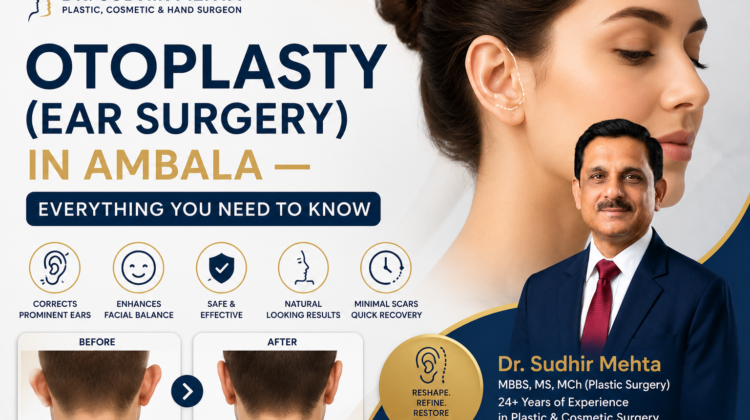
Otoplasty (Ear Surgery) in Ambala — Everything You Need to Know | Dr. Sudhir Mehta
Ears are one of the first features people notice — and for many individuals, prominently protruding or asymmetrical ears can become a source of lifelong self-consciousness. Children face teasing at school. Adults avoid certain hairstyles, glasses, or photographs. For many, it is not vanity — it is simply wanting to feel comfortable in their own appearance.
Otoplasty, commonly known as ear surgery or ear pinning, is one of the most effective and rewarding cosmetic procedures available — delivering natural, permanent results with minimal downtime. Dr. (Prof) Sudhir Mehta, Ambala’s board-certified Plastic and Reconstructive Surgeon, performs otoplasty for both children and adults across Haryana and North India.
What Is Otoplasty?
Otoplasty is a surgical procedure that reshapes, repositions, or reconstructs the outer ear (auricle) to improve its appearance or correct deformities. It is one of the few cosmetic procedures commonly performed in childhood, though it is equally effective and popular among adults.
Otoplasty does not affect hearing in any way. It addresses only the visible, outer structure of the ear — its shape, size, angle, and symmetry.
The procedure is highly customisable. Depending on the concern being addressed, Dr Mehta tailors the surgical approach to each patient’s unique ear anatomy and aesthetic goals.
What Can Ear Surgery Treat?
Otoplasty can address a wide range of ear concerns, including:
- Prominent ears — ears that stick out more than 2 cm from the side of the head (the most common reason for otoplasty)
- Macrotia — ears that are disproportionately large relative to the head
- Cupped ears — ears with an abnormally small or tight outer rim
- Shell ears — ears lacking natural folds and curves
- Lop ears — ears with a tip that folds downward or forward
- Cauliflower ear — a deformity caused by trauma or repeated injury (common in wrestlers and contact sport athletes)
- Earlobe concerns — stretched, torn, or elongated earlobes from heavy jewellery or gauging
- Congenital ear deformities — structural abnormalities present from birth
- Asymmetry — one ear significantly different in shape or position from the other
- Post-trauma reconstruction — restoring ear shape following injury or prior surgery
Types of Otoplasty
1. Ear Pinning (Setback Otoplasty)
The most commonly performed type. The ear is repositioned closer to the head by reshaping the cartilage and removing a small amount of skin behind the ear. The incision is placed in the natural crease behind the ear, making the scar virtually invisible.
2. Ear Reduction (Macrotia Correction)
For ears that are disproportionately large, cartilage and skin are carefully reduced to create a more balanced size relative to the face and head.
3. Ear Augmentation
For ears that are underdeveloped or structurally incomplete, cartilage grafts (often from the ribs) or implants are used to build up and reconstruct the ear’s natural form.
4. Earlobe Repair and Reduction
Stretched, torn, or elongated earlobes are repaired through a straightforward procedure that trims and reshapes the lobe. Recovery is quick, and earlobes can typically be re-pierced after a few months.
5. Congenital Ear Reconstruction (Microtia Repair)
For children born with microtia (underdeveloped or absent outer ear), reconstruction is a complex, multi-stage procedure that uses rib cartilage to create a new ear framework. This is one of the most technically demanding procedures in plastic surgery, requiring a surgeon with specific reconstructive expertise — which Dr. Mehta provides.
Who Is a Good Candidate for Otoplasty?
Otoplasty is suitable for:
- Children aged 5 and above — by age 5, the ear has reached approximately 90% of its adult size, making surgical correction both safe and effective. Early correction prevents teasing and psychological impact during school years.
- Teenagers and adults of any age who are bothered by the appearance of one or both ears
- Individuals in good general health with no active ear infections
- Non-smokers, or those willing to stop smoking well in advance of surgery
- Patients with realistic expectations — understanding that otoplasty improves appearance significantly but aims for natural results, not perfection
Otoplasty is not recommended for very young children under 5, as the ear cartilage is still too soft and developing.
Why Is Otoplasty Done?
People choose otoplasty for both functional and deeply personal reasons:
For children: Protruding ears are one of the most common targets for childhood teasing and bullying. Correcting prominent ears before a child enters school can protect their self-esteem during formative years and spare them years of social difficulty.
For adults: Many adults have lived for decades with self-consciousness about their ears — avoiding short haircuts, wearing their hair long specifically to cover their ears, feeling uncomfortable in photographs or social situations. Otoplasty offers a permanent solution to a concern that may have affected them their entire lives.
Post-trauma or post-surgery: Athletes, accident survivors, or individuals whose ears were damaged by prior procedures benefit from Dr. Mehta’s reconstructive expertise in restoring a natural appearance.
How Should You Prepare for Otoplasty?
Dr Mehta will guide you through every step of preparation during your consultation. Here is what to expect:
Medical Evaluation
- Complete blood count and clotting profile
- Assessment of ear anatomy — shape, cartilage structure, position, and degree of protrusion
- Photographs from multiple angles for surgical planning and comparison
Medication Adjustments
- Stop aspirin, ibuprofen, and all blood-thinning supplements at least 2 weeks before surgery
- Avoid vitamin E, fish oil, and herbal supplements
- Inform Dr Mehta of all medications you are currently taking
Lifestyle Preparation
- Stop smoking at least 4 weeks before surgery — nicotine impairs circulation and wound healing
- Avoid alcohol for one week before the procedure
- For children: prepare them calmly for what to expect — Dr Mehta and his team are experienced in making young patients feel at ease
- Arrange for an adult to drive the patient home after surgery
On the Day of Surgery
- Do not eat or drink for 6–8 hours before the procedure
- Wash your hair the morning of surgery — you will not be able to wash it for a few days after
- Wear comfortable, front-opening clothing — nothing that goes over the head
- Leave jewellery and accessories at home
What Happens During Otoplasty?
Anaesthesia: In children, otoplasty is typically performed under general anaesthesia. In adults, local anaesthesia with sedation is usually sufficient — you are relaxed and comfortable but not fully unconscious.
Duration: The procedure takes approximately 1.5 to 2.5 hours, depending on the complexity and whether one or both ears are being corrected.
The procedure — step by step:
Step 1 — Incision: Dr Mehta makes a small, carefully placed incision in the natural crease directly behind the ear, where it will be completely hidden. For earlobe procedures, the incision is within the earlobe itself.
Step 2 — Cartilage reshaping: Depending on the type of correction needed, the cartilage is either scored (weakened along its length to allow bending), folded and sutured into the desired position, or partially removed. Dr Mehta uses permanent internal sutures to hold the cartilage in its new shape.
Step 3 — Skin adjustment: A small amount of excess skin behind the ear is removed if needed to allow the ear to sit flat against the head naturally.
Step 4 — Closure: Incisions are closed with fine sutures. A soft bandage is wrapped around the head to protect the ears and maintain their new position during initial healing.
Most patients return home the same day.
What Happens After Otoplasty?
Immediately After Surgery (Days 1–3)
- The ears will be wrapped in a bulky bandage or dressing — this is worn continuously for the first 5–7 days
- Mild to moderate pain, throbbing, and a feeling of tightness around the ears is normal and managed well with prescribed pain medication
- Keep the head elevated — including while sleeping — to reduce swelling
- Do not touch, press, or sleep on the ears
Week 1
- At the 5–7 day follow-up, Dr Mehta removes the bandage and replaces it with a lighter headband
- Sutures are also reviewed at this appointment
- Bruising and swelling will be visible but improving
- Most adults can return to desk work within 5–7 days
Weeks 2–4
- A soft headband is worn at night for an additional 4–6 weeks to protect the ears while sleeping and prevent accidental bending
- Children may return to school after approximately 1–2 weeks, with precautions about physical contact
- Avoid contact sports, swimming, and any activity that risks impact to the ears
1–3 Months
- Swelling fully resolves, and the final shape of the ears becomes clearly visible
- Scars behind the ears fade to fine, pale lines — and are completely hidden in the ear’s natural crease
- Results are permanent
Risks and Benefits of Otoplasty
Benefits
- Permanent results — cartilage that has been sutured into position does not return to its previous shape
- Natural appearance — skilled surgical technique produces ears that look naturally positioned, not operated
- Highly discreet scars — hidden entirely behind the ear
- High patient satisfaction — otoplasty consistently ranks among the highest satisfaction procedures in cosmetic surgery
- Psychological impact — significant improvement in self-confidence, particularly in children and young adults
- Quick recovery — most patients resume normal activities within 1–2 weeks
Risks
As with any surgical procedure, otoplasty carries some risks. These are uncommon when surgery is performed by an experienced, board-certified plastic surgeon:
- Infection — managed with antibiotics; very rare with proper technique
- Asymmetry — minor differences between ears are normal; significant asymmetry requiring revision is uncommon
- Scarring — scars are hidden behind the ear and fade well; hypertrophic scarring is rare
- Suture complications — occasionally, sutures may work through the skin surface and require minor attention
- Recurrence — in a small number of cases, the ear may gradually return toward its original position; revision surgery is straightforward
- Changes in skin sensation — temporary numbness around the ear, which typically resolves within weeks to months
- Haematoma — blood collection under the skin; rare and managed promptly
Do’s and Don’ts After Otoplasty
✅ DO:
- Do wear the headbandage for the full recommended period — it is essential for results
- Do sleep on your back with your head elevated for at least 2 weeks
- Do wear the protective headband at night for 4–6 weeks after the bandage is removed
- Do take prescribed antibiotics and pain medication for the full course
- Do keep the surgical area dry and clean as instructed
- Do attend all follow-up appointments with Dr Mehta
- Do contact the clinic immediately if you notice increasing pain, warmth, redness, or discharge
❌ DON’T:
- Don’t touch, rub, or press on the ears during recovery
- Don’t sleep on your side or on your ears for at least 3–4 weeks
- Don’t engage in contact sports, swimming, or gym for at least 6 weeks
- Don’t wear glasses with arms that hook over the ears for the first 4 weeks (use tape to bridge them across the nose instead)
- Don’t pull clothing over your head — use front-opening garments
- Don’t let children run, roughhouse, or engage in physical play that risks ear contact for at least 3 weeks
- Don’t smoke — it severely compromises healing
Recovery and Outlook
What Is the Recovery Time?
Most patients follow this timeline:
- 5–7 days: Bandage removed at follow-up; lighter headband placed
- 1–2 weeks: Return to school or desk-based work
- 4–6 weeks: Resume light exercise, swimming, and contact sports
- 3–6 months: Full results visible; scars fade to fine, pale lines
How Often Will I Need Follow-Up Appointments?
Dr Mehta typically schedules follow-up appointments at:
- 5–7 days — bandage removal, suture check
- 3–4 weeks — progress review, headband guidance
- 3 months — final result assessment, scar review
Additional appointments are arranged as needed.
When Can My Child Go Back to School?
Most children return to school after 1–2 weeks. Dr Mehta will provide a note for school regarding physical education restrictions and the need to wear a protective headband. Peers are usually too focused on the improved appearance to notice anything else.
When to Call Dr Mehta
Contact the clinic immediately if you or your child experiences:
- Sudden increase in pain not controlled by prescribed medication
- Significant swelling, redness, or warmth that is worsening rather than improving
- Fever above 38°C
- Discharge or bleeding from the wound
- The bandage feels excessively tight or causes unusual discomfort
- A suture breaking through the skin surface
Clinic number: +91-9729058872 — available for urgent queries.
Results — What to Expect
Otoplasty delivers some of the most consistent and satisfying results in all of cosmetic surgery. Patients — and parents of young patients — consistently describe the change as profound:
- Ears that sit naturally against the head, proportionate to the face
- No visible scarring — the incision line disappears into the crease behind the ear
- A permanent result — the reshaped cartilage holds its position long-term
- A transformation in how patients carry themselves — hairstyle choices, photograph comfort, social confidence
- For children: freedom from teasing and the ability to focus on growing up without self-consciousness about their appearance
The goal of otoplasty is never to make ears look “operated” — it is to make them look as though they were always naturally positioned. In skilled hands, that is exactly the result patients achieve.
Frequently Asked Questions
Q: At what age is otoplasty safest for children?
Most plastic surgeons, including Dr Mehta, recommend waiting until the child is at least 5 years old — when the ear cartilage is firm enough for reliable reshaping, and the ear has reached close to adult size. Many parents choose to have the procedure done before the child starts school to prevent teasing.
Q: Will otoplasty leave visible scars?
No incisions are placed in the natural crease directly behind the ear. Once healed, the scar is hidden and fades to a fine, pale line that is not visible from the front or sides.
Q: Is otoplasty permanent?
Yes. The internal sutures hold the cartilage in its new position permanently. In rare cases (less than 5%), gradual movement may occur, which can be corrected with a straightforward revision procedure.
Q: Can both ears be done at the same time?
Yes — in fact, operating on both ears in a single session is standard practice when both require correction. This ensures symmetry and avoids two separate recovery periods.
Q: Can adults have otoplasty?
Absolutely. There is no upper age limit. Adult ear cartilage is firmer than a child’s, but an experienced plastic surgeon like Dr Mehta achieves excellent, lasting results in adult patients.
Q: Can I wear glasses after otoplasty?
Glasses with arms that hook over the ears should be avoided for the first 4 weeks. During this period, they can be taped to the nose bridge. Contact lenses can be worn once comfort allows.
Book Your Otoplasty Consultation in Ambala
Whether it is for your child or for yourself, otoplasty offers a safe, permanent, and life-improving solution to ear concerns that may have gone unaddressed for years.
Dr. (Prof) Sudhir Mehta brings 24+ years of plastic and reconstructive surgical expertise to every consultation — with a calm, patient-centred approach that puts both adult patients and children at ease from the very first visit.
📍 Manocha Eye Hospital (SM Aesthetics), Arya Chowk, near Arya Samaj School, Police Line, Ambala, Haryana 134003 📞 +91-9729058872 ✉️ drsudhirmehta1@gmail.com 🕙 Mon–Sat: 10 AM to 7 PM | Sunday: By Prior Appointment