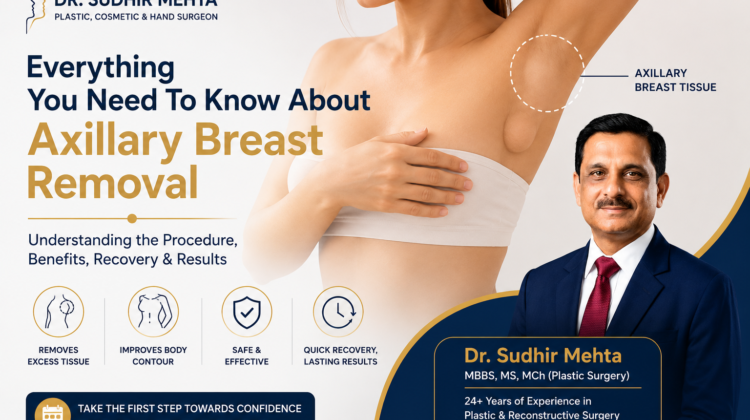
Everything You Need To Know About Axillary Breast Removal
What Is Axillary Breast Removal?
Axillary breast removal, also known as accessory breast tissue excision, is a surgical procedure to remove excess breast tissue located in the armpit (axilla) region. This tissue develops embryologically — during foetal development, a “milk line” runs from the armpit to the groin, and in some individuals, breast tissue develops along this line outside the normal breast area.
The tissue can be glandular (true breast tissue), fatty, or a combination of both. It may be barely noticeable or appear as a visible, palpable lump in the armpit — one that may enlarge during menstruation, pregnancy, or breastfeeding, just like normal breast tissue does.
Day case: most patients go home the same day
Who Is a Suitable Candidate for Axillary Breast Removal Surgery?
You may be a good candidate for this procedure if you experience any of the following:
- A visible or palpable lump in one or both armpits that grows during hormonal changes
- Discomfort, pain, or chafing in the axillary region, particularly during physical activity
- Difficulty fitting into clothing, particularly sleeveless tops, fitted shirts, or bras
- Self-consciousness about the appearance of the underarm area
- Swelling or tenderness that worsens during menstruation or pregnancy
- Good overall health with no uncontrolled medical conditions
- Realistic expectations about the outcome of surgery
Preparation for Axillary Breast Removal
A thorough pre-operative assessment is essential for a safe outcome. During your consultation with Dr. Sudhir Mehta, you can expect:
- A clinical examination of the axillary tissue to confirm the diagnosis and assess its extent
- An ultrasound or MRI in some cases to rule out other causes (lymph nodes, lipoma, etc.)
- Blood tests and a pre-operative health assessment
- Discussion of anaesthesia options — local with sedation, or general anaesthesia
- Instructions to stop blood-thinning medications (aspirin, ibuprofen) 7–10 days before surgery
- Smokers are asked to stop at least 4 weeks before and after the procedure
- Fasting instructions if general anaesthesia is planned
- Arrangements for someone to drive you home and stay with you on the day of surgery
Procedure for Axillary Breast Removal
What Will Happen During Your Surgery?
The surgical approach depends on the type and extent of the axillary tissue present. Key points during the procedure include:
- The surgery is performed under local anaesthesia with sedation or general anaesthesia, depending on the amount of tissue to be removed and patient preference
- A small, carefully placed incision is made within or near a natural skin fold in the armpit to minimise visible scarring
- If the tissue is primarily fatty, liposuction may be used alone or in combination with direct excision
- If glandular (true breast) tissue is present, it must be surgically excised — liposuction alone cannot remove glandular tissue effectively
- The surgeon meticulously identifies and preserves surrounding nerves, blood vessels, and lymphatic structures
- The excised tissue is routinely sent for histopathological (laboratory) analysis to rule out any pathological changes
- The incision is closed with fine, absorbable or removable sutures and dressed with a compression bandage
What Is Recovery Like After Axillary Breast Tissue Removal Surgery?
Recovery is generally well-tolerated. Most patients are pleasantly surprised by how manageable the process is. Here is what to expect week by week:
Mild to moderate swelling, bruising, and tenderness in the armpit area. A compression garment or bandage is worn. Rest is important. Arm movement should be gentle — avoid raising the arm above shoulder height. Prescribed pain relief keeps discomfort minimal.
Swelling and bruising begin to reduce noticeably. Most patients return to desk-based or sedentary work. Sutures are removed (if non-absorbable) around day 7–10. Light walking is encouraged.
Full range of arm movement typically returns. Light domestic activities resume. Strenuous exercise and heavy lifting remain restricted. Scarring begins to mature and fade.
Most patients feel fully recovered. Gym sessions and upper-body exercise can resume gradually, as cleared by Dr Mehta. The axillary contour is now visible as the swelling fully resolves.
Scars continue to fade and flatten. The final result is fully apparent. Regular scar massage (as advised) helps achieve the smoothest outcome.
Dos after axillary breast tissue removal surgery
- Wear your compression garment as instructed — it significantly reduces swelling and supports healing
- Keep the wound clean and dry, following Dr Mehta’s dressing instructions precisely
- Take prescribed antibiotics and pain relief for the full recommended course
- Attend all follow-up appointments so healing can be monitored and concerns addressed early
- Eat a protein-rich diet and stay well hydrated to support tissue repair
- Begin gentle arm movements as soon as advised — early, careful mobilisation prevents stiffness
- Sleep with the affected arm slightly elevated on a pillow for the first week
- Apply scar treatment (silicone gel or sheet) once the wound has fully closed, as recommended
Don’ts after axillary breast tissue removal surgery
- Do not lift heavy objects or raise your arms above shoulder height for the first two weeks
- Avoid any strenuous exercise, gym sessions, or sports for at least four to six weeks
- Do not shave or use deodorant in the affected armpit until the wound has fully healed
- Avoid soaking in baths, swimming pools, or hot tubs until cleared by your surgeon
- Do not expose the scar to direct sunlight without SPF protection for at least one year
- Avoid smoking throughout the recovery period — it significantly impairs wound healing
- Do not remove dressings or sutures yourself
Risks and Complications of Axillary Breast Removal
Axillary breast removal is a well-established, generally safe procedure. As with any surgery, it carries a small set of potential risks that patients should be aware of:
- Temporary swelling, bruising, and tenderness — expected and self-resolving
- Scarring — minimised by careful incision placement and good scar management
- Temporary altered sensation or numbness in the inner arm or axilla — usually resolves within weeks to months
- Seroma (fluid collection) — may require drainage in the clinic if it develops
- Wound infection — rare; treated with antibiotics
- Asymmetry — when both sides are treated, the surgeon’s technique minimises this risk
- Recurrence — very rare with complete excision; more likely if tissue was incompletely removed
During your consultation, Dr Mehta will discuss your individual risk profile and explain how each of these risks is minimised in his practice.
Schedule a Consultation
Concerned about axillary breast tissue? Book a confidential consultation with Dr Sudhir Mehta in Ambala for an expert assessment and honest advice.
Frequently Asked Questions
Is axillary breast tissue cancerous?
Axillary breast tissue itself is not cancerous — it is benign accessory tissue. However, because it is true breast tissue, it carries the same (very small) risk of developing breast cancer as normal breast tissue. This is one reason why all tissue removed during surgery is routinely sent for laboratory analysis. Any concerns about a rapidly changing or painful axillary lump should prompt a prompt medical review.
Can men get axillary breasts?
Yes. While far more common in women, men can also develop axillary breast tissue. It arises from the same embryological process and can present in exactly the same way — as a soft lump in the armpit that may enlarge with hormonal changes. Men may seek removal for comfort, cosmetic reasons, or to rule out other causes.
Will there be any scars after axillary breast surgery?
Yes, some scarring is inevitable with any surgical procedure. However, Dr Mehta places incisions carefully within the natural skin folds of the armpit, where they are hidden when the arm is in a neutral position. With good scar management — including silicone gel and sun protection — most scars fade to a fine, barely visible line within 12 months.
When is consultation with the doctor needed after the axillary breast removal surgery?
You should contact Dr Mehta’s clinic immediately if you experience: increasing redness, warmth, or swelling around the wound; a fever above 38°C; unusual discharge from the incision site; or sudden, severe pain not controlled by your prescribed medication. Routine follow-up appointments are scheduled at day 7–10, and then at 4–6 weeks post-surgery.
Is axillary breast removal surgery permanent?
Yes — when the axillary tissue is fully excised, it does not grow back. The results are considered permanent. However, significant weight gain may cause remaining fatty tissue in the area to enlarge, so maintaining a stable weight contributes to long-lasting results.