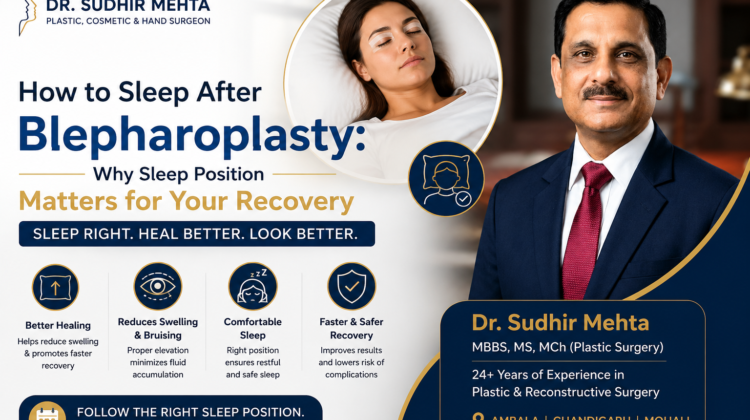
How to Sleep After Blepharoplasty: Why Sleep Position Matters for Your Recovery
You’ve had your eyelid surgery, the procedure went smoothly, and now comes a question almost every patient asks: “How am I supposed to sleep tonight?” The answer matters more than most people realise — your sleep position in the days after blepharoplasty can directly influence swelling, bruising, and how quickly you heal.
Why Sleep Position Matters After Eyelid Surgery
During upper or lower eyelid surgery, the delicate skin, muscle, and fat around your eyes are gently repositioned and refined. In the hours and days that follow, this tissue is naturally swollen and more fragile than usual. Gravity plays a major role in how fluid moves through this area — and sleep is the one time of day when you have the least control over your body’s position.
If your head is flat or tilted downward overnight, fluid tends to pool around the eyes, leading to more pronounced swelling and bruising by morning. On the other hand, keeping your head elevated helps fluid drain away from the surgical site, supporting a smoother and faster recovery.
Best Position: Head Above Heart
The golden rule after blepharoplasty is simple: keep your head elevated above the level of your heart, both day and night. This single habit does more to control post-surgical swelling than almost anything else you can do.
How to achieve this comfortably
- Use two to three pillows to prop yourself up at a 30–45 degree angle
- Alternatively, sleep in a recliner chair for the first few nights
- A wedge pillow designed for post-surgical recovery can help maintain a stable incline all night
- Keep your head, neck, and shoulders aligned to avoid neck strain
How Long Do I Have to Sleep Upright After Eyelid Surgery?
Most patients are advised to maintain an elevated sleeping position for at least the first 5 to 7 days after surgery — the window during which swelling and bruising are at their peak. Some surgeons recommend continuing this for up to two weeks for optimal results, especially after combined upper and lower eyelid procedures.
| 5–7 days
Minimum elevated sleeping period |
30–45°
Recommended head elevation angle |
2 weeks
Side-sleeping typically remains restricted |
Dr. Sudhir Mehta will give you a personalised recovery timeline based on whether you had upper, lower, or combined blepharoplasty, as well as your individual healing response.
Preventing Movement During Sleep
Even with the right elevation, restless movement during the night can disturb healing tissue. A few simple strategies can help:
- Build a “pillow nest” around your shoulders and sides to limit rolling over
- Place a body pillow alongside you as a physical reminder to stay on your back
- Keep the bedroom cool — overheating can increase the urge to toss and turn
- Avoid heavy meals, caffeine, or alcohol close to bedtime, as these can disrupt sleep quality
- Use cold compresses (as advised by your surgeon) before bed to reduce swelling and discomfort that might otherwise wake you
When Can You Sleep on Your Side After Blepharoplasty?
Side sleeping puts direct pressure on the eyelids and surrounding tissue, which can worsen swelling, cause asymmetry, or even put gentle pressure on healing incisions. Most surgeons advise against side or stomach sleeping for at least the first two weeks.
Once swelling has substantially reduced and your surgeon confirms the incisions have healed well — usually around the two-week mark — you can gradually reintroduce side sleeping. Start by alternating sides and avoid sleeping directly on your face.
What Not to Do After Eyelid Surgery
- Do not sleep flat on your back or stomach during the first one to two weeks
- Do not rub, scratch, or apply pressure to your eyes, even if they feel itchy
- Avoid bending forward or lifting heavy objects, as this increases blood flow to the face and worsens swelling
- Do not skip prescribed eye drops or ointments, even if your eyes feel fine
- Avoid screens for extended periods in the first few days, as eye strain can increase discomfort
- Do not remove sutures or steri-strips yourself — leave this to Dr. Mehta’s team
- Avoid direct sun exposure and skip wearing contact lenses until cleared by your surgeon
What Is the Fastest Way to Recover from Upper Eyelid Surgery?
While everyone heals at their own pace, certain habits consistently support faster recovery:
- Strict head elevation, day and night, for the first week
- Cold compresses during the first 48 hours to minimise swelling and bruising
- Gentle walking from day one to encourage healthy circulation, without strenuous exercise
- Staying well hydrated and eating a balanced, low-sodium diet to reduce fluid retention
- Attending all follow-up appointments so Dr Mehta can monitor healing and address concerns early
- Being patient — final results typically reveal themselves over four to six weeks as residual swelling resolves
What Really Happens in Upper Eyelid Surgery?
Upper eyelid surgery
During upper blepharoplasty, Dr Mehta makes a fine incision along the natural crease of the eyelid. Excess skin, and sometimes a small amount of muscle or fat, is carefully removed or repositioned. Because the incision sits within the eyelid’s natural fold, the resulting scar is virtually invisible once healed.
Recovery
In the first two to three days, mild swelling, bruising, and a feeling of tightness around the eyes are completely normal. Sutures are typically removed within seven to ten days, after which most patients feel comfortable returning to light social activities. Make-up can usually be worn again once the surgical team confirms the incisions have closed properly.
See the difference
The transformation after upper blepharoplasty is often described as looking more rested, alert, and naturally youthful — without appearing “overdone”. Because the procedure also opens up the upper field of vision in patients with drooping eyelids, many notice a functional improvement alongside the cosmetic one.
What to Expect From Your Blepharoplasty Consultation and Procedure
At your initial consultation
Your journey begins with a detailed, one-on-one consultation with Dr Sudhir Mehta. During this visit, he will:
- Review your medical history, current medications, and any eye conditions
- Examine your eyelid skin, muscle tone, and fat distribution
- Discuss whether your concern is primarily functional (vision-related) or cosmetic, or both
- Set realistic expectations for your individual results and recovery timeline
- Answer all your questions about anaesthesia, technique, cost, and aftercare
From here, Dr Mehta will recommend whether upper, lower, or combined blepharoplasty is right for you, and walk you through every step of the procedure, recovery, and the sleep and care routine you’ll need to follow for the best possible outcome.
| Schedule a Consultation
Have questions about your blepharoplasty recovery, or thinking about eyelid surgery for the first time? Book a consultation with Dr Sudhir Mehta in Ambala today. Book an appointment: drsudhirmehta.com/appointment |
Frequently Asked Questions
Can I sleep on my side after eye surgery?
Not immediately. Side sleeping puts pressure directly on the healing eyelid tissue and can increase swelling or asymmetry. Most patients should avoid side sleeping for at least the first two weeks, gradually reintroducing it once Dr Mehta confirms the incisions have healed.
How do you lie face down after eye surgery?
Lying face down is generally not recommended in the early recovery period, as it directly compresses the eyelids and can disrupt healing. If you are someone who naturally sleeps on your stomach, plan with extra pillows and a recliner setup so you can comfortably stay elevated and on your back instead.
What’s the best way to elevate my head while sleeping?
A wedge pillow or two to three regular pillows stacked to create a 30–45 degree incline works well. Make sure your neck is supported too, not just your head, to avoid waking up with stiffness.
Will swelling go away completely?
Yes. Most visible swelling and bruising resolve within two to three weeks, while subtle residual swelling can take four to six weeks to fully settle, revealing your final result.
When can I go back to using my phone or laptop?
Light screen use is usually fine after the first day or two, but extended screen time should be avoided in the first week as eye strain can increase discomfort and dryness.
Manocha Eye Hospital, Arya Chowk, near Police Line, Ambala, Haryana 134003
Phone: +91-9729058872
Email: drsudhirmehta1@gmail.com
Hours: Mon–Sat: 10 AM – 7 PM | Sunday: By appointment