Keloid vs Hypertrophic Scar: What Is the Difference and How Are They Treated?
Scars are a natural part of the body’s healing process. Whenever the skin is injured due to surgery, an accident, burns, cuts, or other trauma, the body produces collagen and new tissue to repair the damaged area. Most scars gradually become less noticeable with time, but some can become thick, raised, itchy, painful, or more prominent than expected.
Two types of raised scars that are often confused with each other are Keloid vs Hypertrophic Scar.
Although they may look similar, they are not the same. The most important difference is how far the scar tissue grows in relation to the original wound.
What Is a Keloid Scar?
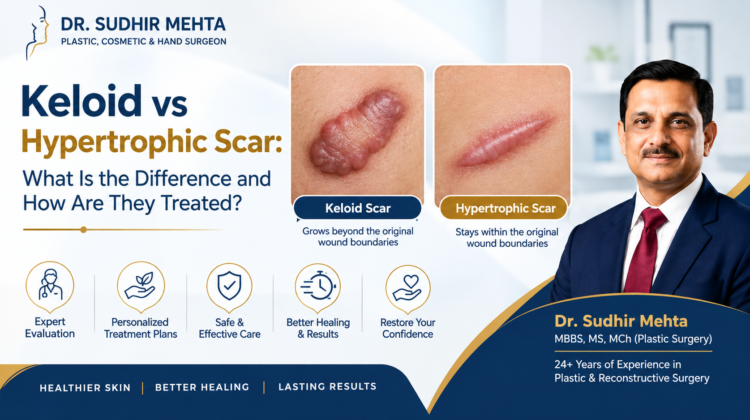
A keloid is a type of raised scar in which scar tissue grows beyond the original boundaries of the wound.
Keloids may develop after relatively minor skin injuries, including:
- Surgical incisions
- Cuts or injuries
- Burns
- Acne
- Piercings
- Insect bites or other skin trauma
A keloid may continue to enlarge over time and can become firm, raised, itchy, painful, or uncomfortable. Keloids can occur on different parts of the body, with some areas such as the chest, shoulders, neck and ears being more commonly affected.
Because keloids can extend beyond the original injury, they may become more noticeable than the initial wound itself.
What Is a Hypertrophic Scar?
A hypertrophic scar is also raised and thickened, but there is an important difference: it generally remains within the boundaries of the original wound.
Hypertrophic scars often develop relatively soon after an injury or surgical procedure. They may appear red or darker than the surrounding skin and can sometimes cause itching, tenderness, or discomfort.
Unlike keloids, hypertrophic scars may gradually become flatter and less noticeable as they mature.
Keloid vs Hypertrophic Scar: Key Differences
Understanding the difference can help explain why the treatment approach may vary.
| Feature | Keloid Scar | Hypertrophic Scar |
|---|---|---|
| Growth | Can extend beyond the original wound | Usually stays within the original wound |
| Appearance | Raised, thick and firm | Raised and thick |
| Growth over time | May continue to enlarge | Often stabilizes and may improve |
| Symptoms | May cause itching, pain or tenderness | May cause itching, tenderness or discomfort |
| Natural improvement | Less likely to flatten completely without treatment | May gradually become flatter |
| Treatment | Often requires a combination approach | Treatment depends on size, symptoms and location |
The appearance alone is not always enough to determine the exact type of scar. A medical examination can help identify the scar type and guide appropriate treatment.
Why Do Some People Develop Raised Scars?
Scar formation varies from person to person. Several factors can influence how a scar develops, including the type and depth of the original injury, the location of the wound, how the wound heals, genetics, and individual skin characteristics.
People who have previously developed keloids may also have a higher tendency to develop them again after future skin injuries or procedures.
This is why anyone with a history of keloid formation should discuss their tendency for raised scars with a qualified doctor before undergoing elective procedures, piercings, or other skin trauma.
Can Keloids and Hypertrophic Scars Be Treated?
Yes. Treatment can help make many raised scars smaller, flatter, softer, less noticeable or less symptomatic. However, there is no single treatment that works equally well for every scar.
The treatment selected depends on factors such as:
- Type of scar
- Size and thickness
- Location
- Age of the scar
- Symptoms such as itching or pain
- Skin characteristics
- Previous treatments
- Whether the scar has returned after earlier treatment
A specialist may recommend one treatment or a combination of treatments depending on the individual case.
Common Treatment Options for Raised Scars
1. Silicone Gel or Silicone Sheets
Silicone-based products may be recommended for certain raised scars. They can help reduce scar thickness, redness, stiffness and other symptoms when used appropriately and consistently.
They are generally used after the wound has closed, and treatment may need to continue for an extended period.
2. Corticosteroid Injections
Corticosteroid injections are commonly used for raised scars and keloids. The medication is injected directly into the scar tissue and may help reduce its size and relieve symptoms such as itching or pain.
Multiple treatment sessions may sometimes be needed.
3. Other Injectable Treatments
Depending on the scar and individual circumstances, a specialist may consider other injectable medications, sometimes in combination with corticosteroids.
The choice should be based on the type and characteristics of the scar rather than using the same treatment for every patient.
4. Laser and Light-Based Treatments
Certain laser or light-based treatments may help improve the appearance of scars, including redness, thickness, texture and other symptoms.
Laser treatment may sometimes be combined with other therapies to achieve better results.
5. Cryotherapy
Cryotherapy uses controlled freezing to treat certain raised scars. It may help reduce the size and symptoms of some keloids and hypertrophic scars.
In selected cases, it may be combined with other treatments such as injections.
6. Scar Revision Surgery
In some cases, surgical scar revision may be considered to improve the appearance or function of a scar.
Scar revision does not simply mean making a scar disappear. Surgery creates a new wound to replace or modify an existing scar so that the resulting scar is more favourable in appearance, position or function.
For keloids, surgery may need to be combined with additional treatment because recurrence can occur.
Can an Old Scar Still Be Treated?
An older scar may still be treatable. However, the appropriate approach depends on its type, thickness, location, appearance and how long it has been present.
Different scar treatments work for different scar patterns. For example, treatments designed to flatten raised scars are not necessarily suitable for depressed or pitted scars.
This is why an individual assessment is important before choosing a treatment.
How Can You Reduce the Risk of Excessive Scarring?
While it is not always possible to prevent abnormal scarring, proper wound care can support better healing.
Some general measures include:
- Follow your doctor’s wound-care instructions.
- Keep the healing wound clean and appropriately protected.
- Avoid unnecessary irritation or trauma to the area.
- Protect healing scars from excessive sun exposure.
- If you have previously developed a keloid, inform your doctor before future procedures.
Sun exposure can make scars appear darker, so appropriate sun protection is also important during scar maturation.
When Should You See a Plastic Surgeon?
You should consider professional evaluation if a scar:
- Is becoming increasingly raised or thick
- Extends beyond the original wound
- Becomes painful or itchy
- Feels tight and affects movement
- Continues to increase in size
- Is causing significant cosmetic concern
- Has returned after previous treatment
A scar that changes unexpectedly should also be evaluated rather than assumed to be a normal scar.
Final Thoughts
Keloids and hypertrophic scars may look similar, but they behave differently. A keloid can grow beyond the original wound, whereas a hypertrophic scar generally remains within the boundaries of the original injury.
Because scar type, size, location, and individual healing characteristics all influence treatment, there is no single solution that is appropriate for everyone. A qualified plastic surgeon can assess the scar and recommend an individualized treatment plan.
If you have a raised, thick, itchy, or unusual scar and are considering treatment, professional evaluation is the right first step.
Scar Evaluation and Treatment in Ambala
Dr. (Prof.) Sudhir Mehta is a board-certified Plastic, Cosmetic & Hand Surgeon practicing in Ambala, with more than 24 years of experience. His practice provides personalized care across plastic, reconstructive, and aesthetic procedures.
For consultation and evaluation:
Dr. (Prof.) Sudhir Mehta
Plastic, Cosmetic & Hand Surgeon
Ambala, Haryana
Call / WhatsApp: +91 97290 58872
Email: drsudhirmehta1@gmail.com
Note: Every scar is different. Treatment recommendations should be made after an individual clinical assessment. The information in this article is for general awareness and should not be considered a substitute for medical consultation.