Superficial vs Deep Burn: Clinical Pehchaan Kaise Karein?
A burn injury can look different depending on how deeply the skin and underlying tissues have been damaged. Burn depth is an important part of clinical assessment because it influences healing potential, treatment decisions, risk of scarring, and the possible need for surgery.
But identifying burn depth is not always as simple as looking at the wound. Clinical assessment generally considers appearance, blanching/capillary refill, pain and sensation, along with the mechanism and progression of the injury.
This article explains the key clinical differences between Superficial vs. deep burns in simple terms.
What Is a Superficial Burn?
A superficial burn primarily affects the epidermis, the outermost layer of the skin.
Typical clinical features include:
- Red or pink appearance
- Dry skin
- No significant blistering in a purely superficial/epidermal burn
- Pain or tenderness
- Brisk blanching or capillary refill
- Preserved sensation
- Good healing potential
Superficial burns generally heal through regeneration of the skin and usually do not result in significant scarring.
A common example is a mild sunburn.
What About Superficial Partial-Thickness Burns?
It is important not to confuse a purely superficial burn with a superficial partial-thickness burn.
A superficial partial-thickness burn extends into the superficial dermis. It commonly presents with:
- Blisters
- A moist, pink or red wound bed
- Significant pain
- Brisk blanching when pressure is applied
- Preserved sensation
These burns generally have good healing potential, although the healing period is longer than for an epidermal burn.
What Is a Deep Burn?
As burn depth increases, more of the dermis and potentially the full thickness of the skin becomes involved.
Deep burns may include deep partial-thickness and full-thickness burns. Their clinical appearance can vary, but several features can help during assessment.
Deep Partial-Thickness Burn
A deep partial-thickness burn involves deeper portions of the dermis.
It may appear:
- Pale, white or mottled
- Drier than a superficial partial-thickness burn
- Less likely to blanch normally
- Less painful in some areas because nerve endings have been damaged
- With delayed or sluggish capillary refill
Deep partial-thickness burns have a lower healing potential than superficial burns and may take considerably longer to heal. Prolonged healing increases the risk of scarring and contracture, and some wounds may require surgical management.
Full-Thickness Burn
A full-thickness burn destroys the epidermis and dermis and may extend into the underlying subcutaneous tissue.
Typical features can include:
- White, brown, grey or black appearance
- Dry, leathery or stiff texture
- No normal blanching
- Reduced or absent sensation within the burned area
- Destruction of nerve endings
- Poor spontaneous healing potential
Because the skin’s full thickness has been destroyed, larger full-thickness burns generally require specialist management and may require surgical treatment such as excision and skin grafting.
Superficial vs Deep Burn: Key Clinical Differences
| Clinical Feature | Superficial Burn | Deeper Burn |
|---|---|---|
| Depth | Mainly epidermis / superficial dermis depending on category | Deep dermis or full thickness |
| Appearance | Red or pink | Pale, white, mottled, leathery or charred |
| Moisture | Usually dry for epidermal burns | Often drier as depth increases |
| Blisters | Absent in purely superficial burns | May occur in partial-thickness burns |
| Blanching | Usually brisk | Sluggish or absent in deeper injury |
| Capillary refill | Usually brisk | Delayed or absent |
| Pain | Usually painful | May decrease with increasing depth |
| Sensation | Preserved | May be reduced or absent |
| Healing potential | Generally good | Decreases as depth increases |
| Scarring risk | Usually low | Higher with deeper/prolonged-healing wounds |
| Surgery | Usually not required | May be required depending on depth and extent |
These findings are useful clinical indicators, but no single feature should be considered in isolation.
Why Is Capillary Refill Important?
Blanching or capillary refill is one of the clinical observations used when assessing burn depth.
When pressure is applied to a viable, well-perfused burn wound, the area may temporarily become lighter and then regain its colour as blood flow returns.
A superficial partial-thickness burn generally demonstrates brisk blanching, while deeper burns may show sluggish or absent blanching because the vascular structures within the damaged tissue are compromised.
However, capillary refill should be interpreted together with the wound’s appearance and sensory findings.
Does More Pain Always Mean a More Severe Burn?
Not necessarily.
This is an important point for medical students and anyone assessing a burn.
Superficial and superficial partial-thickness burns can be very painful because many nerve endings remain intact. As a burn becomes deeper, nerve endings can be damaged, so sensation and pain may decrease.
Therefore, a painless burn should not automatically be considered a minor burn. Full-thickness burns may have little or no sensation in the centre of the injury because of nerve destruction.
How Does Burn Depth Affect Healing?
Burn depth has a major influence on healing.
Superficial injuries retain structures that can help regenerate the skin, so they generally heal more readily.
With deeper burns, progressively more of these structures are destroyed. As a result, healing becomes slower and the risk of problematic scarring and contracture increases.
In general:
Superficial → better healing potential → lower risk of significant scarring
Deep → slower healing → higher risk of scarring/contracture → possible need for surgery
The exact healing time varies according to burn depth, size, location, infection, patient factors, and treatment.
Why Burn Depth Can Be Difficult to Determine
One of the challenges in burn care is that burn depth may not always be obvious during the first examination.
Deep partial-thickness burns can sometimes initially appear similar to more superficial injuries. Burn wounds can also evolve, and their appearance may change during the first few days.
For this reason, clinical assessment may need to be repeated, particularly when the depth is uncertain.
An experienced burn or plastic surgery team considers:
- Mechanism of injury
- Time since injury
- Wound appearance
- Blanching/capillary refill
- Pain and sensation
- Presence and character of blisters
- Wound progression
- Healing response
No single clinical sign is sufficient in every case.
Can a Deep Burn Heal Without Surgery?
It depends on the depth, size, location, and healing progress.
Some partial-thickness burns can heal with appropriate wound care. However, deeper burns that are unlikely to heal within an acceptable period may require surgical intervention.
Full-thickness burns generally have very limited spontaneous healing potential because the structures required for skin regeneration have been destroyed. Larger full-thickness injuries commonly require specialist surgical management, which may include removal of damaged tissue and skin grafting.
When Should a Burn Be Medically Evaluated?
Medical evaluation is particularly important when a burn is:
- Deep, white, leathery or charred
- Associated with significant blistering or extensive skin damage
- Large or rapidly worsening
- Located on the face, hands, feet, genital area, or major joints
- Circumferential around an arm, leg, chest, or other body part
- Caused by electricity or chemicals
- Associated with breathing difficulty or suspected inhalation injury
- Causing significant functional limitation
Cleveland Clinic recommends professional medical care for full-thickness burns and for larger partial-thickness burns.
First Aid: What Should You Do Immediately?
For many thermal burns, the priority is to stop the burning process and cool the affected area with cool running water. Avoid ice and household remedies such as butter or other substances that can further damage the skin. Blisters should not be intentionally broken.
For significant, deep, or extensive burns, first aid should be followed by appropriate medical assessment.
Key Takeaway for Medical Students
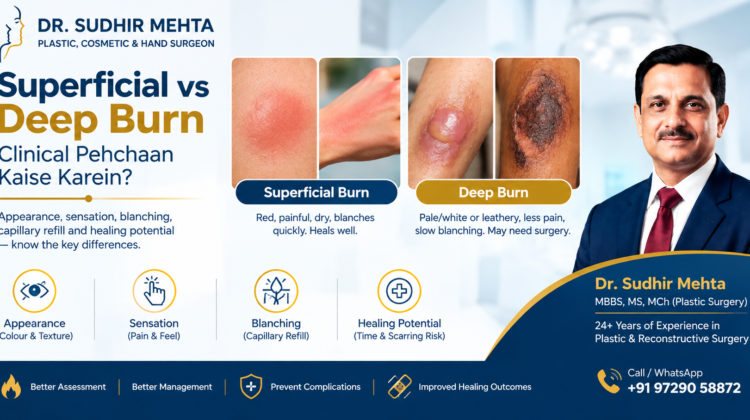
When revising burn depth, remember the four important clinical parameters:
Appearance + Blanching + Sensation + Healing Potential
A useful conceptual comparison is:
Superficial burn
Red/pink → painful → brisk blanching → sensation preserved → good healing potential
Deep burn
Pale/white/mottled/leathery → sensation may be reduced → sluggish/absent blanching → poorer healing potential
However, real-world burn assessment is more nuanced than memorising a table. Burn depth can be difficult to determine early, and serial clinical assessment may be necessary.
Final Thoughts
Identifying burn depth is an essential part of burn assessment. Superficial injuries generally have better healing potential, while deeper injuries carry greater risks of delayed healing, scarring, contractures and the need for surgical treatment.
If you or someone in your family has suffered a significant burn, do not rely solely on appearance or pain level to judge its severity. A qualified medical professional should assess the depth, size, location, and overall condition of the patient before deciding on treatment.
Expert Plastic & Reconstructive Surgical Care in Ambala
Dr. Sudhir Mehta
MBBS, MS, MCh (Plastic Surgery)
Plastic, Cosmetic & Hand Surgeon
Ambala, Haryana
Call / WhatsApp: +91 97290 58872
This article is intended for general educational purposes and does not replace an individual medical examination or emergency medical care.