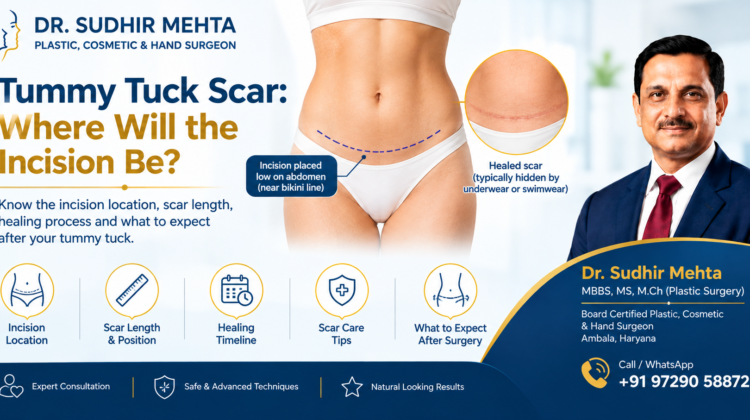
Tummy Tuck Scar: Where Will the Incision Be?
For many patients considering tummy tuck surgery (abdominoplasty), one of the most common questions is: “Nishaan exactly kahan rahega?”
A tummy tuck can improve the contour of the abdomen by removing excess skin and fat and, when appropriate, tightening the abdominal wall. However, because the procedure involves an incision, a scar is an expected part of the healing process. The goal is generally to place and close the incision carefully so that the resulting scar is as discreet and concealable as reasonably possible.
Where Is the Tummy Tuck Scar Located?
In a standard or full tummy tuck, the main incision is usually placed low across the lower abdomen, often extending from one hip area toward the other. Surgeons generally aim to position it close to the pubic region so that the healed scar can be concealed by underwear or swimwear.
The exact position is not identical for every patient. It can depend on factors such as:
- Amount of excess skin
- Abdominal anatomy
- Type of tummy tuck being performed
- Previous abdominal scars, including a C-section scar
- Skin quality and elasticity
- Surgical technique
- Patient’s preferred underwear or swimwear line
This is why scar placement should be discussed during the consultation rather than assuming that every tummy tuck produces exactly the same scar.
How Long Is a Tummy Tuck Scar?
The length of the scar depends largely on the amount of excess skin being removed and the type of abdominoplasty.
A conventional tummy tuck commonly produces a hip-to-hip or lower-abdominal scar. A mini tummy tuck generally involves a shorter incision, while more extensive procedures may require longer incisions.
For some patients who have undergone significant weight loss, a circumferential or extended procedure may be recommended. Such procedures can create scars extending farther around the sides of the body.
Will There Also Be a Scar Around the Belly Button?
In a full tummy tuck, the position of the belly button may need to be adjusted after excess abdominal skin is removed.
This can result in a scar around the navel in addition to the lower-abdominal scar. The details depend on the surgical technique and the patient’s individual anatomy.
What Does a Tummy Tuck Scar Look Like Initially?
It is normal for a new surgical scar to look more noticeable during the early healing period.
Initially, the incision may appear:
- Red or pink
- Slightly raised
- Swollen
- Firm or uneven
This does not necessarily represent the final appearance of the scar.
Scar maturation is a gradual process. Over the following months, the scar generally becomes flatter and lighter as collagen remodels. Plastic surgery scars can continue to mature for six months to a year or longer, depending on the individual.
Tummy Tuck Scar Healing Timeline
Every patient heals differently, but the scar generally changes through several stages.
First Few Weeks
The incision is still actively healing. Your surgeon may use dressings, Steri-Strips or other wound-care measures, depending on the surgical technique.
During this period, following postoperative instructions is particularly important. Avoid unnecessary tension, friction or activities that your surgeon has restricted.
First Few Months
The scar may remain pink, red or darker than the surrounding skin. It may also feel firm or slightly raised.
This can be part of normal scar maturation rather than an indication that something is wrong.
Six Months to One Year
As collagen remodeling continues, the scar often becomes softer, flatter and less noticeable. However, scar maturation can continue beyond one year in some patients.
Important: A tummy tuck scar is permanent, although its appearance can improve significantly over time. It is more realistic to aim for a well-healed, discreet, and strategically positioned scar rather than an invisible scar.
Can a Tummy Tuck Scar Be Hidden?
One of the main principles of tummy tuck incision planning is to place the scar where it can be concealed by clothing.
A low abdominal incision may be hidden beneath:
- Underwear
- Bikini bottoms
- Swimwear
- Many types of everyday clothing
However, the final position needs to balance concealment with the amount of skin that needs to be removed and the patient’s anatomy.
It is helpful to discuss your preferred clothing or swimwear style with your plastic surgeon before surgery.
What Can Affect the Final Appearance of the Scar?
Several factors influence how a tummy tuck scar eventually looks.
1. Surgical Technique
Careful incision planning and closure can help create a more refined scar. Scar management actually begins during surgery, particularly through appropriate handling of the tissues and control of tension.
2. Individual Healing
Everyone’s skin heals differently. Genetics, skin type, and the body’s individual scar-forming response can influence the final appearance.
3. Tension on the Incision
Excessive tension or stress during healing can affect scar quality. Patients should follow their surgeon’s activity restrictions and gradually return to normal activities as advised.
4. Sun Exposure
A healing scar can become more noticeable with sun exposure. Appropriate sun protection is therefore an important part of long-term scar care.
5. Postoperative Scar Care
Once the incision has completely healed and your surgeon allows it, scar-management options such as silicone gel or silicone sheets may be recommended. Other treatments can sometimes be considered for persistent redness, thickness or texture changes.
What About an Existing C-Section Scar?
Patients who have previously had a C-section often ask whether they will have two separate scars.
In some cases, the existing C-section scar can be incorporated into the tummy tuck incision. However, this depends on the location of the previous scar, the amount of skin being removed, and the planned surgical technique.
Your surgeon can assess the existing scar during consultation and explain how it may be incorporated into the surgical plan.
Does a Mini Tummy Tuck Have a Smaller Scar?
Generally, a mini tummy tuck involves a shorter lower-abdominal incision than a full abdominoplasty. However, it is not suitable for everyone.
The choice between a mini and full tummy tuck depends on the location and amount of excess skin, abdominal contour, muscle condition and the patient’s individual goals.
The objective is not simply to choose the procedure with the smallest scar, but to choose the procedure that appropriately addresses the patient’s concerns.
When Should You Contact Your Surgeon About a Scar?
Some changes during healing are expected, but patients should contact their surgical team if they notice concerning symptoms such as:
- Increasing redness or warmth
- Increasing pain rather than gradual improvement
- Significant drainage or pus
- Fever
- Wound separation
- Sudden changes around the incision
Early evaluation can help identify and manage complications appropriately.
Frequently Asked Questions
Is a tummy tuck scar permanent?
Yes. The scar remains permanently, but it generally becomes softer, flatter, and lighter as it matures.
Can the tummy tuck scar be completely invisible?
No surgical scar can be guaranteed to disappear completely. The goal is usually to create a well-healed and discreet scar that can be concealed under underwear or swimwear.
How long does a tummy tuck scar take to fade?
Scar maturation varies, but noticeable improvement generally occurs over several months, with further maturation continuing for around a year or longer in some patients.
Does everyone have the same tummy tuck scar?
No. Scar length and position depend on the procedure, anatomy, excess skin, previous scars and surgical planning.
Can scar treatments improve its appearance?
Certain treatments, including silicone-based products and selected laser or other scar treatments, may help in appropriate cases. These should be discussed with your surgeon and used according to their postoperative advice.
Final Takeaway
A tummy tuck does leave a scar, but where that scar is placed and how it heals are important parts of surgical planning.
For most standard tummy tucks, the main incision is positioned low on the abdomen with the aim of allowing the healed scar to be concealed by underwear or swimwear. The exact length and position depend on your anatomy, the amount of excess skin and the surgical technique.
If you are considering abdominoplasty, an individual consultation is the best way to understand where your incision is likely to be, what type of tummy tuck may be appropriate, and what scar-healing plan may be recommended for you.
Tummy Tuck Consultation with Dr. Sudhir Mehta
Dr. Sudhir Mehta – Official Website
Dr. (Prof.) Sudhir Mehta is an MBBS, MS, M.Ch. (Plastic Surgery) qualified, board-certified Plastic, Cosmetic & Hand Surgeon practicing in Ambala. His website lists Tummy Tuck (Abdominoplasty) among his cosmetic surgery expertise.
Clinic: Manocha Eye Hospital, Arya Chowk, near Arya Samaj School, Police Line, Ambala, Haryana 134003
Call / WhatsApp: +91 97290 58872
This article is for general educational information and does not replace an individual consultation, examination or medical advice.