
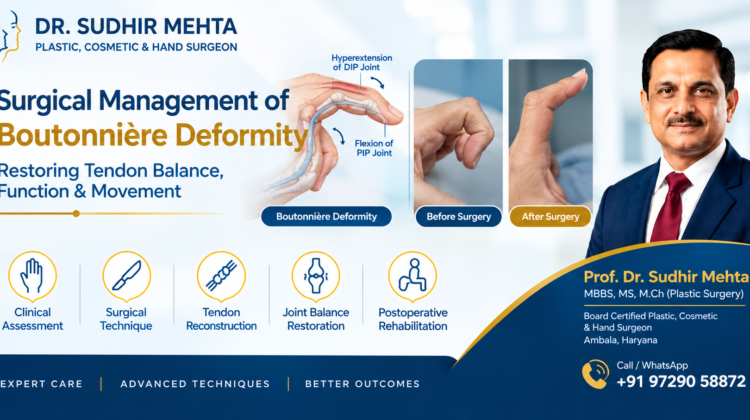
Surgical Management of Boutonnière Deformity
A Boutonnière deformity is a finger deformity characterized by flexion of the proximal interphalangeal (PIP) joint with relative hyperextension of the distal interphalangeal (DIP) joint. It commonly develops after disruption of the central slip of the extensor tendon, which is responsible for extending the PIP joint.
The condition may result from trauma, a jammed or dislocated finger, an open tendon injury, or inflammatory conditions such as rheumatoid arthritis. If the deformity becomes established or does not respond adequately to conservative treatment, surgical reconstruction may be considered depending on the patient’s anatomy, chronicity, joint flexibility, and functional requirements.
Understanding the Anatomy
The extensor mechanism of the finger is a finely balanced structure. The central slip inserts into the middle phalanx and contributes to PIP joint extension, while the lateral bands continue distally toward the DIP joint. When the central slip is disrupted, the lateral bands can migrate volarly, changing the balance of forces across the finger. This contributes to PIP flexion and DIP hyperextension.
This explains why Boutonnière deformity is not simply a problem of a “bent finger.” It is a problem involving tendon balance, joint mechanics, and the extensor mechanism.
What Causes Boutonnière Deformity?
Common causes include:
- A forceful blow to the back of a flexed PIP joint
- Jammed or sports-related finger injuries
- Volar PIP dislocation
- Laceration or open injury involving the central slip
- Avulsion of the central slip, sometimes associated with a small bone fragment
- Rheumatoid arthritis and associated inflammatory changes around the PIP joint
The deformity may not always be obvious immediately after the injury. In some cases, the characteristic posture develops over the following days or weeks as the extensor mechanism becomes progressively imbalanced.
Clinical Assessment
Diagnosis is primarily clinical and involves a careful examination of the finger.
The surgeon assesses:
- PIP joint position and extension lag
- DIP joint posture and movement
- Passive correction of the PIP deformity
- Tendon excursion and extensor mechanism balance
- Joint stability
- Previous injury or surgery
- Presence of associated fracture or bony avulsion
The Elson test is an important clinical examination maneuver for suspected central slip injury. It assesses the function of the central slip by examining finger extension with the PIP joint flexed.
Radiographs may also be useful, particularly when an injury could involve a bony avulsion, joint subluxation, or other structural abnormality.
When Is Surgery Considered?
Not every Boutonnière deformity requires surgery. Many acute closed central-slip injuries can initially be managed with appropriate PIP extension splinting and hand therapy.
Surgical treatment may be considered in selected patients when there is:
- An open or significantly disrupted tendon injury
- A displaced bony avulsion or associated structural injury
- Persistent symptomatic deformity despite appropriate conservative treatment
- A chronic deformity affecting hand function
- Significant loss of active PIP extension
- A deformity that requires reconstruction after the finger has become mechanically imbalanced
The choice of procedure depends on whether the deformity is flexible or fixed, the condition of the PIP joint, the integrity of the extensor mechanism and the duration of the deformity.
Surgical Management of Boutonnière Deformity
In a surgical case, the objective is not simply to straighten the finger. The surgeon must restore the balance of the extensor mechanism while preserving as much useful joint movement as possible.
A procedure may involve several carefully planned steps.
1. Assessment of Finger Excursion
Before proceeding with reconstruction, the finger is assessed to understand its active and passive movement.
This helps determine:
- How much PIP flexion is present
- Whether the deformity is passively correctable
- The available tendon excursion
- The condition of the surrounding soft tissues
- The degree of joint stiffness
This assessment helps guide the reconstructive strategy.
2. Surgical Exposure
A Brunner’s zig-zag incision can be used when appropriate to provide exposure while respecting the anatomy of the finger.
Careful soft-tissue handling is important because excessive scarring can further compromise finger movement and tendon glide.
3. Identification of the Extensor Mechanism
The structures surrounding the PIP joint are carefully identified.
The surgeon evaluates the:
- Central slip
- Lateral bands
- Dorsal structures
- PIP joint
- Volar plate and surrounding tissues
The exact surgical findings can vary considerably from one patient to another.
4. Repair of the Dorsal Plate
Where indicated, the damaged dorsal structures may be repaired to help restore the anatomy and stability of the PIP joint.
The repair must be performed without creating excessive tension that could restrict postoperative movement.
5. Double-Breasting Repair of the Central Slip
The central slip is an important component of PIP extension.
A double-breasting technique may be used in selected cases to reinforce and restore the central extensor mechanism. The goal is to achieve adequate tendon continuity while maintaining appropriate tension.
6. Dorsal Suturing of the Volarised Lateral Slips
With a chronic Boutonnière deformity, the lateral bands may have migrated toward the volar aspect of the finger.
Their repositioning and dorsal suturing can help restore the extensor mechanism’s normal force direction.
This is a technically demanding step because too much or too little tension can affect the final range of motion.
7. Assessment After Correction
After reconstruction, the finger is reassessed for:
- PIP extension
- DIP movement
- Tendon excursion
- Alignment
- Joint stability
- Overall balance of the extensor mechanism
The aim is to achieve functional correction rather than simply obtaining a straight appearance.
Why Surgical Precision Matters
The PIP joint is highly sensitive to stiffness and changes in tendon balance. A reconstruction that is excessively tight can restrict flexion, while inadequate correction may leave persistent extension lag or deformity.
For this reason, successful management requires an understanding of:
Tendon anatomy + joint mechanics + tissue balance + postoperative rehabilitation
The surgical procedure is only one part of recovery. Appropriate postoperative splinting, controlled movement, and hand therapy may be important for protecting the reconstruction while gradually restoring function.
Surgery vs Conservative Treatment
| Aspect | Conservative Management | Surgical Management |
|---|---|---|
| Typical role | Many acute closed injuries | Selected chronic, severe, or structurally significant cases |
| Main approach | PIP extension splinting + therapy | Tendon/joint reconstruction depending on pathology |
| Goal | Protect and allow healing | Restore tendon balance and correct established deformity |
| Rehabilitation | Important | Essential |
| Decision factors | Injury type and flexibility | Chronicity, joint condition, tendon integrity and function |
Treatment should be individualized rather than based only on how the finger looks.
Recovery After Surgery
Recovery varies according to the procedure performed, severity of the deformity and condition of the joint and soft tissues.
Postoperative management may involve:
- Protective splinting
- Controlled range-of-motion exercises
- Hand therapy
- Gradual strengthening
- Monitoring of tendon healing and joint mobility
Patients should understand that full correction and normal movement cannot always be guaranteed, particularly in long-standing deformities or when joint stiffness and degenerative changes are present.
Key Takeaway
Boutonnière deformity is a complex problem of the finger’s extensor mechanism. The characteristic PIP flexion and DIP hyperextension develop because disruption of the central slip alters the normal balance of the lateral bands and extensor tendon system.
When surgery is indicated, the procedure requires meticulous assessment of the central slip, lateral bands, PIP joint and surrounding soft tissues. Techniques such as central slip reconstruction and repositioning of volarised lateral bands may be used in appropriately selected cases.
Early assessment of a finger injury is important because treatment options can become more complex as the deformity becomes chronic.
Surgical Management by Prof. Dr. Sudhir Mehta
Prof. Dr. Sudhir Mehta
MBBS, MS, M.Ch (Plastic Surgery)
Board Certified Plastic, Cosmetic & Hand Surgeon
Ambala, Haryana
For patients with persistent finger deformity, restricted movement, or suspected extensor tendon injury, a specialist hand evaluation can help determine the appropriate treatment pathway.
Call / WhatsApp: +91 97290 58872
This article is intended for educational purposes and does not replace an individual clinical examination or medical advice.